Balikan: Where Geometry Meets Calligraphy
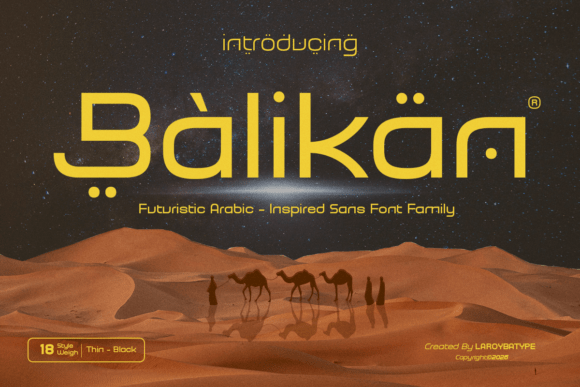
Every designer hits a point where the usual suspects—the Helvetica, the Futura, the Open Sans—start to feel a bit too safe. You’re working on a brand that needs to whisper luxury but shout innovation. You need a typeface that feels grounded in history but is sprinting toward the future. Enter Balikan. It’s not just another geometric sans-serif; it’s a bridge between two worlds. This font family takes the rigid, clean precision of modern geometry and softens it with the sweeping, elegant nuances of Arabic calligraphy. The result is a typeface that feels futuristic yet familiar, structured yet fluid.
If you’ve been searching for a premium font that breaks away from the sterile look of standard tech typography, Balikan offers a refreshing alternative. It doesn’t scream for attention with jagged edges or chaotic kerning. Instead, it commands the room with smooth curves and a distinct personality. It’s the kind of typeface that makes a viewer pause and look twice, wondering how a sans-serif can feel so organic. Whether you are building a brand identity from scratch or refreshing a magazine layout, understanding how to leverage this unique aesthetic is key to unlocking its potential.
The Visual Personality: More Than Just Letters
At its core, Balikan is a sans serif font, but it refuses to be boring. The magic lies in the details. If you look closely at the letterforms, you’ll notice subtle strokes and endings that mimic the flow of a nib pen, reminiscent of Naskh or Thuluth scripts, yet stripped of any complex ligatures or hard-to-read loops. This makes it incredibly functional. You get the artistic flair of a script font without sacrificing the legibility of a modern typography staple.
This "Arabic-inspired" quality isn't just about the shapes of the letters; it's about the rhythm. Traditional Western geometry often feels static—lots of perfect circles and straight lines. Balikan introduces a dynamic flow. The terminals might flare slightly, or a curve might feel more organic than mechanical. This creates a visual texture that feels rich and expensive. It’s a creative font choice for anyone who wants to avoid the cold, robotic vibe that often plagues tech-centric design. It brings warmth to the digital screen and elegance to printed paper.
Strategic Applications: Where Balikan Shines
Knowing a font looks cool is one thing; knowing how to use it is another. Balikan is a powerhouse display font, making it an exceptional candidate for hero sections on websites, logo design, and large-scale packaging design. Imagine a luxury skincare brand or a high-end audio tech company using Balikan for their wordmark. It immediately signals that the brand is forward-thinking and culturally aware.
However, don't box it in as just a headline font. Because of its clean structure, it holds up surprisingly well in semi-body text, particularly in editorial design. If you are laying out a magazine spread about architecture, travel, or technology, Balikan can pull double duty. It sets a sophisticated tone for headers while remaining readable for pull quotes and sub-headers.
Here are a few specific scenarios where Balikan excels:
- Tech & Crypto Startups: The geometric precision appeals to the tech crowd, while the calligraphic nuances suggest a "human" element in AI or blockchain projects.
- Event Branding: Perfect for film titles, festival posters, or gala invitations where you need a creative font that feels distinct and high-end.
- Social Media Graphics: In a feed full of generic sans-serifs, Balikan’s unique curves can stop the scroll. It works beautifully for quote cards and promotional banners.
- App Interfaces: For apps focused on lifestyle, meditation, or travel, using Balikan for headers can add a touch of elegance to the web design without hurting the user experience.
Mastering the Pair: Readability and Hierarchy
A common mistake with distinctive display fonts is trying to use them for everything. While Balikan is readable, using it for long paragraphs of 10pt text might fatigue the reader's eye because of its unique personality. The best practice for font pairing is to let Balikan do the heavy lifting for the headlines, and pair it with a neutral, highly legible sans-serif or even a traditional serif font for the body copy.
Think about contrast. If you pair Balikan with a sturdy, standard sans-serif like Roboto or Inter, the distinctiveness of Balikan pops even more. Alternatively, pairing it with a classic handwritten font or a delicate serif can create a beautiful juxtaposition between the future and the past. This balance is crucial for establishing visual hierarchy. You want your audience to know exactly where to look first. Balikan naturally draws the eye, making it an anchor for your most important messages.
Practical Guide: Licensing and Implementation
Before you integrate Balikan into your next big project, you need to treat it like any other professional design asset. First, check the licensing. If you are using this for a client’s logo or a product sold commercially, you need a commercial license. Using a free version for a personal blog is fine, but scaling it to packaging design or merchandise requires the proper paperwork to avoid legal headaches down the road.
Next, review the styles included in the family. A strong font family usually comes with multiple weights—Light, Regular, Bold, Black—and perhaps italics. Test these out. Often, the "Bold" weight of a geometric font like this has a massive presence that is perfect for logos, while the "Light" weight might be better suited for elegant sub-headings in editorial design.
Finally, test it in context. Don't just look at it in a font preview tool. Drop it into your actual mockups. See how it looks on a dark background versus a light one. Check the kerning (the spacing between letters) in your specific headline. Sometimes, a premium font needs minor tracking adjustments depending on the size you are using.
The Verdict on Balikan
In a market saturated with generic geometric typefaces, Balikan offers a breath of fresh air. It respects the rules of modern typography but bends them just enough to create something with soul. It is a commercial font that feels like a piece of art. For the designer looking to elevate a brand, or the entrepreneur wanting to stand out in a crowded digital space, Balikan provides the tools to build a visual identity that is both professional and deeply engaging. It proves that you don’t have to choose between being modern and being cultural—you can absolutely be both.